


What is IRS Form 1065?
Form 1065 is the U.S. return used by partnerships to report income, deductions, credits, and other tax items, and to pass those amounts through to partners via Schedule K-1.
📢 Attention Nonprofits! Filed an Extension? E-File Your 2025 Form 990 Series by Nov 16 to Meet Your Extended Deadline.
E-File Now!📢Attention Partnerships! E-file Your 2025 Form 1065 online and securely deliver Schedule K-1s to partners.
E-file your partnership’s income tax return with ease. TaxZerone provides a secure and accurate platform for filing Form 1065 online, whether you operate a domestic partnership or a multi-member LLC taxed as a partnership.
File Form 1065 Online for just $179.99
One flat fee. No hidden charges. Your complete 1065 e-filing includes Schedule K-1 generation for all partners.
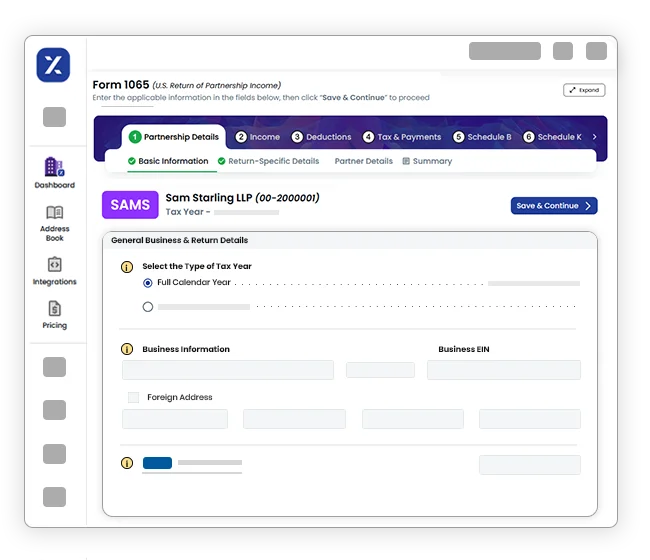
To file IRS Form 1065 through TaxZerone, ensure you have the following:
Filing again next year? TaxZerone securely stores your past filings so you can reuse partnership and partner details for faster filing.
Before you file, make sure your business qualifies:
If your business meets these criteria, you are generally required to file IRS Tax Form 1065 to report the partnership’s income and issue Schedule K-1s to partners for their individual or entity returns.
Still Unsure?
Contact Our Support
Every domestic partnership is generally required to file Form 1065, U.S. Return of Partnership Income, unless it has no income, deductions, or credits to report for the tax year. This includes partnerships formed under state law and multi-member LLCs classified as partnerships for federal tax purposes.
Foreign partnerships must file Form 1065 if they have income effectively connected with a U.S. trade or business or have U.S. source income. Filing is required even if the partnership’s main operations are outside the U.S. or if all partners are foreign persons.
Filing your Form 1065 is quick and streamlined—just follow these steps:
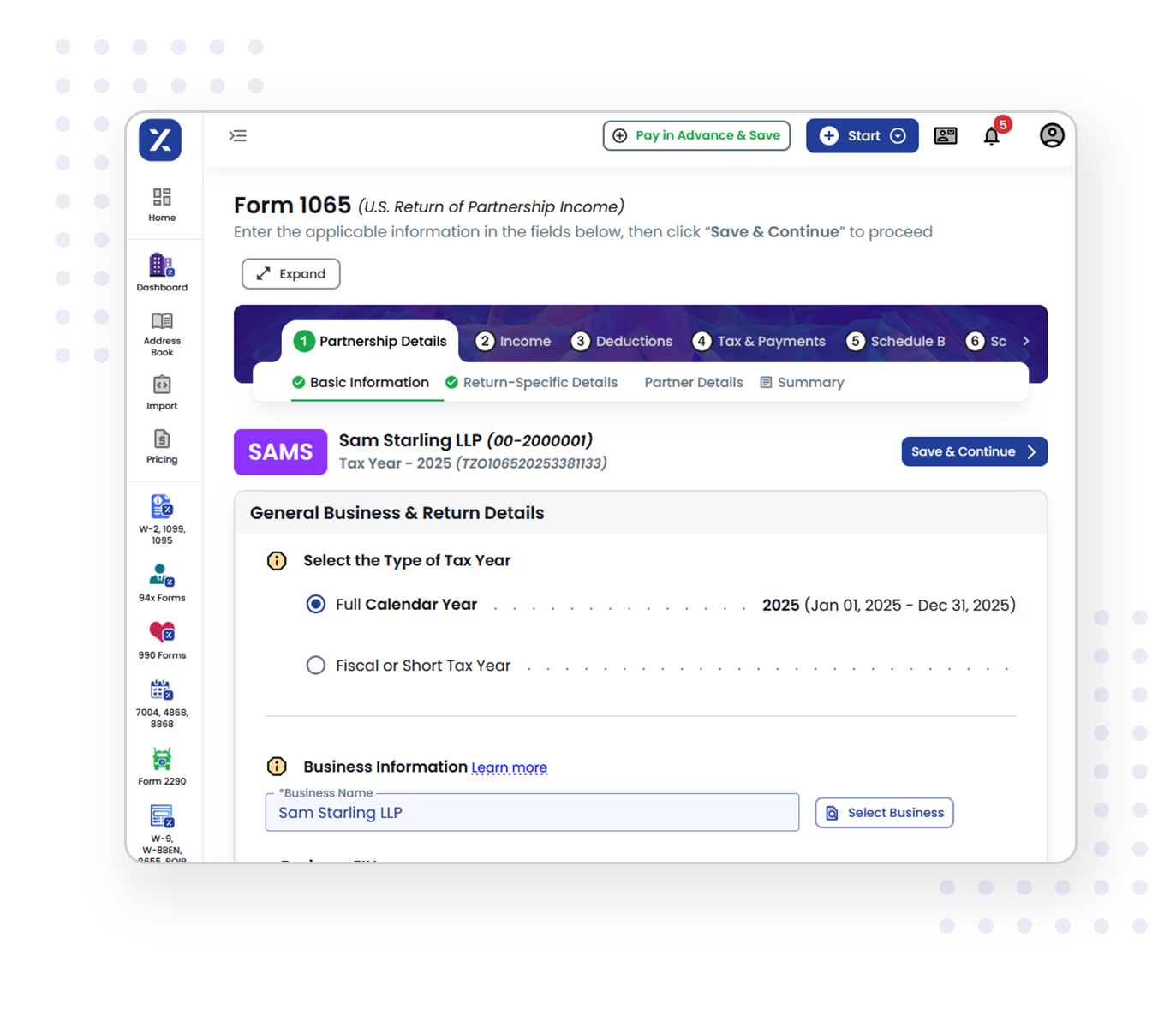

Choose Form 1065 after login and enter partnership and partner details using our intuitive interface.

Enter business income, deductions, and other tax items while automatically creating K-1s for each partner.

Run built-in checks to confirm that your return is complete and compliant with IRS rules, then transmit electronically.

After acceptance, deliver K-1s digitally via ZeroneVault or send by mail using our add-on services.

File your partnership return on a reliable, IRS-compliant platform that ensures smooth processing.

Step-by-step screens guide you through each part of Form 1065 and associated schedules, following the IRS Form 1065 instructions.

Generate irs tax form 1065 Schedule k 1 for every partner and support electronic and postal delivery.

Reuse prior-year data for returning partnerships to accelerate setup and reduce data entry.

Automatic validation helps identify missing TINs, inconsistent totals, and other common 1065 errors.

No surprise fees—just a clear base price and optional add-ons that scale with your needs.
Starting or managing a partnership comes with important tax responsibilities, but filing your first form 1065 irs is easier than you think. TaxZerone streamlines the process so you can focus on running your business instead of decoding IRS forms.

Handling multiple partnership returns? Enjoy volume savings and additional support.
📞 Contact Us Now to unlock your custom CPA pricing and streamline partnership filings.
These deadlines apply if your partnership uses a calendar year (Jan 1 – Dec 31).
| Filing Type | Deadline |
|---|---|
| File with IRS (E-file) | March 16, 2026 |
| Partner K-1 Distribution | March 16, 2026 |
| With Extension (Form 7004) | September 15, 2026 |
If your partnership uses a fiscal year, the Form 1065 due date is:
The 15th day of the 3rd month after the fiscal year ends.
Examples:
Fiscal year ending June 30, 2026 → Form 1065 due September 15, 2026.
Fiscal year ending September 30, 2026 → Form 1065 due December 15, 2026.
You can request a Form 1065 extension by e-filing Form 7004 on or before the original due date. This provides an automatic 6-month extension to file your return.

Avoid penalties by filing a complete and accurate return on time.
If you are unsure, contact a CPA or our support team to help you reduce the risk of errors and penalties.
Avoid penalties, save time, and stay compliant—file your partnership return securely with TaxZerone.
Form 1065 is the U.S. return used by partnerships to report income, deductions, credits, and other tax items, and to pass those amounts through to partners via Schedule K-1.
Pass-through entities are business structures like partnerships or multi-member LLCs that do not pay federal income tax at the entity level. Instead, the income or losses pass through directly to the owners, who report them on their personal or business tax returns. Form 1065 is the tax form used to report this income to the IRS.
Form 1065 is the partnership's overall tax return, reporting total income, deductions, and credits. Schedule K-1 is a detailed statement issued to each partner, showing their specific share of the partnership’s income, deductions, and credits, which they use to complete their individual tax returns.
Schedule k 1 form 1065 irs reports each partner’s share of partnership income, deductions, credits, and other items so partners can include them on their own tax returns.
By default, a multi-member LLC is usually treated as a partnership and may need to file Form 1065, while a single-member LLC is generally disregarded and files on the owner’s return unless it elects a different classification.
Yes, the IRS strongly encourages e-filing. Partnerships filing a certain number of returns or with more than 100 partners are generally required to file electronically according to the IRS Tax Form 1065 instructions.
Late or incomplete filing can lead to per-partner penalties, additional charges on unpaid tax, and separate penalties for late or incorrect K-1s.
Yes. When the IRS 1065 Form is filed, partners must use the information from their Schedule K-1 to report their share of partnership income, deductions, and credits on their individual federal and, if applicable, state tax returns.